

Is It Easier To Build A Clean Room Underground?
Volition we always… live in underground homes?
(Paradigm credit:
City of Helsinki
)
As cities get more crowded, why not build downward? Kieran Nash profiles some of the earth's most unusual surreptitious constructions, from Australian stone homes to Beijing's subterranean spaces.
I
In many respects, Bernadette Roberts' three-bedroom house is similar any other. "Lounge, dining surface area, kitchen – information technology's got all the mod cons. It's like a normal home."
Only it's not a normal abode – Roberts lives surreptitious. She's a resident of Coober Pedy, a tiny town 846km n of Adelaide, South Australia, that is known for two things: its opal mines, and its "dugouts" – subterranean homes carved from the rock, which business firm 80% of the town'due south population.
Coober Pedy is an inhospitable place, where temperatures tin can reach 50C. A century ago, miners realised it was much libation to live beneath ground, and the town's residents have stayed there ever since.
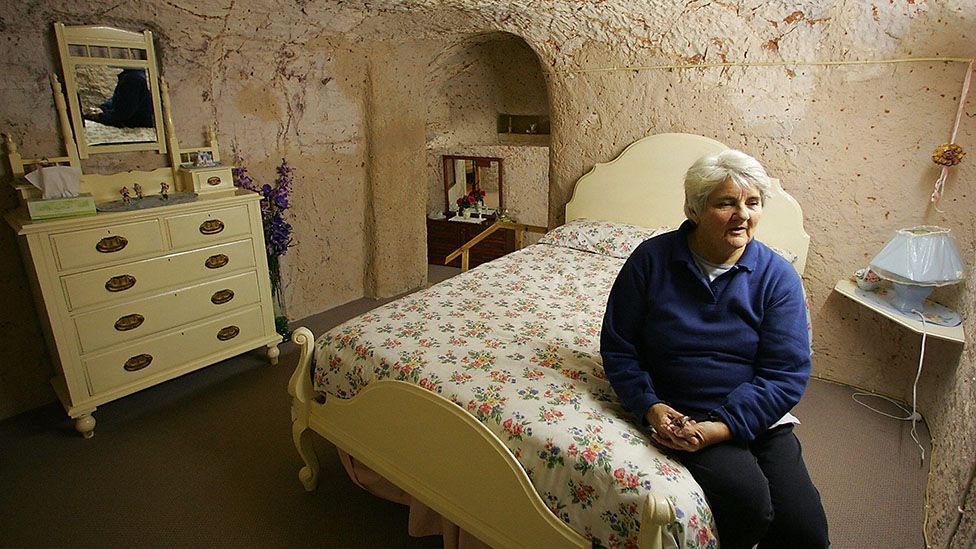
A subterranean sleeping accommodation in Coober Pedy (Credit: Torsten Blackwood/AFP/Getty)
Roberts says "on a practiced day", when temperatures exterior are in the loftier 30s or low 40s, the temperature in her dugout is effectually 23 to 25C. "It's similar you've walked into an air-conditioned room."
While extreme weather has forced Coober Pedy's residents underground, it'south not the only place on Earth where authorities are looking beneath the surface for new urban space.
With two-thirds of the world'southward population expected to live in cities by 2050, urban land is expected to go an increasingly limited resources. Many cities – due to space constraints, heritage areas, or other factors – cannot build up, or out. But what about down?
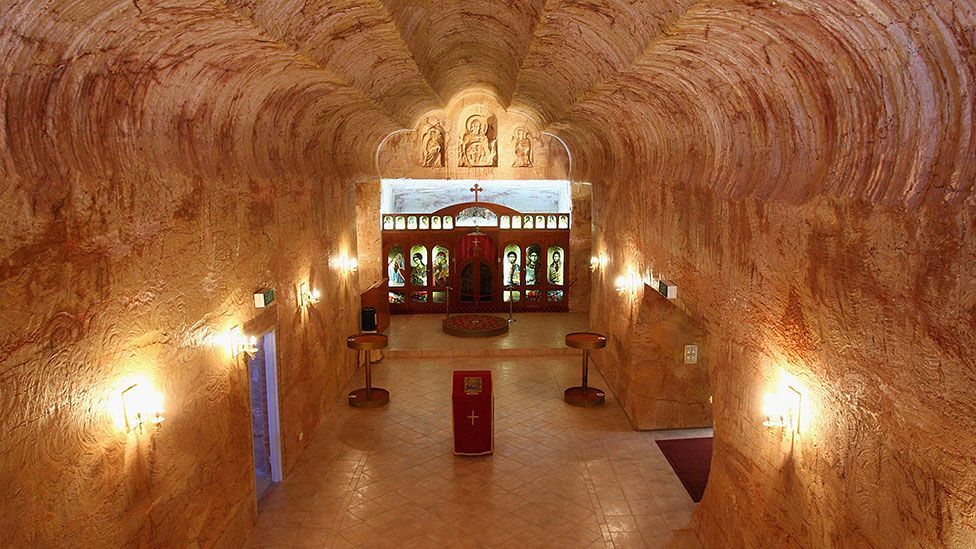
An underground church in the opal mining boondocks of Coober Pedy in Australia (Credit:Quinn Rooney/Getty)
Consider the case of Singapore, one of the almost crowded countries on the planet. Its population of nearly 5.five meg people is squeezed into a metropolis state that covers just 710 sq km. "For Singapore, the principal thrust for going surreptitious is really to solve the land shortage upshot," says Singapore-based Zhou Yingxin of the Associated Research Centers for the Urban Underground Space, a non-governmental organisation of experts who design and analyse cities' subterranean spaces.
"Traditionally, we've tried to repossess land by digging up the sea and buying sand, but that is becoming less and less feasible – the sea is getting deeper, we're getting to the boundaries, the sand is getting more expensive, our neighbours are complaining and all that."
So, 1 plan currently on the tabular array is an Hush-hush Science City (USC). Designed to firm a 300,000 sq thou enquiry and development facility thirty-80m beneath the surface, the USC will support biomedical and biochemistry industries, among others. If completed, information technology is estimated to house a working population of 4,200.
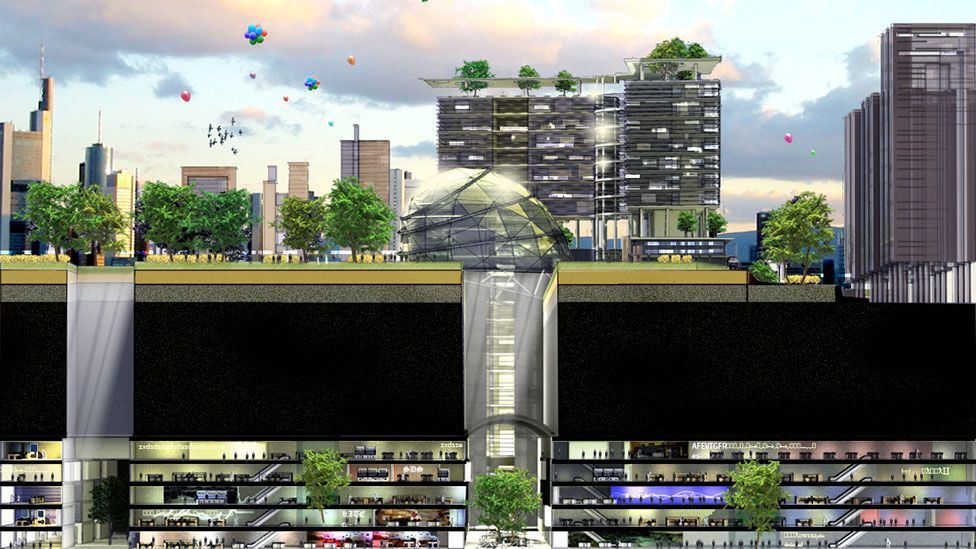
A blueprint for Singapore's Undercover Science Metropolis (Credit: JTC Corporation)
In other cases, land is deficient considering of heritage restraints. In Mexico City, for instance, there are strict edifice restrictions in its historic centre. That's why architecture firm BNKR Arquitectura has designed a massive, 300m-deep inverted pyramid dubbed the Earthscraper.
The proposed building would firm 5,000 people, with terraced floors receiving natural light from a huge glass ceiling above – although the lower floors will need actress lighting with fibre optics.
BNKR founding partner and CEO Esteban Suarez hopes the Earthscraper volition inspire a new "species" of building.
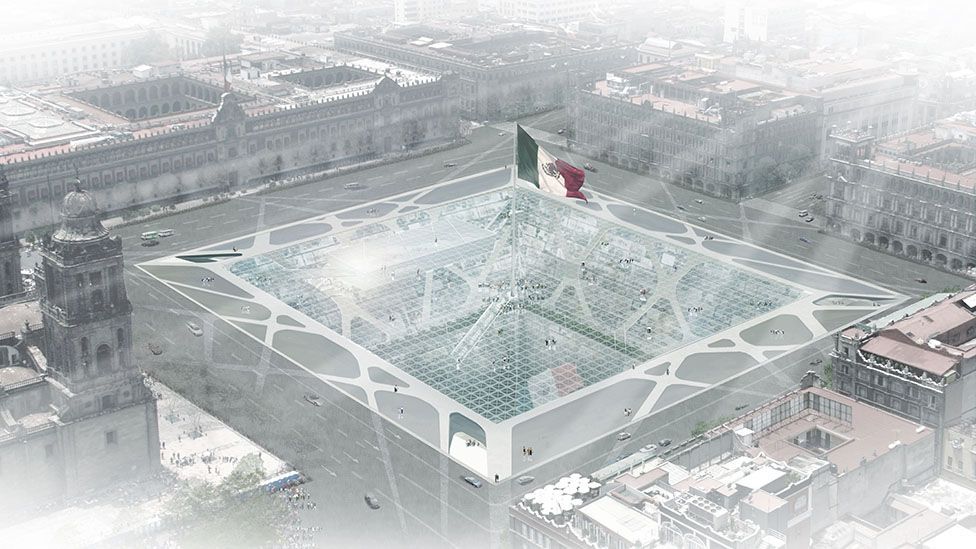
The proposed Earthscraper in United mexican states City (Credit: BNKR Arquitectura)
Meanwhile, in People's republic of china, demand for affordable housing in Beijing is forcing people to motion below the surface in less glamorous conditions.
Annette Kim, director of the University of Southern California's Spatial Analysis Lab, spent virtually a year in China's capital from 2022 to 2022 studying the conditions for those living in the city'due south underground housing – a mixture of former bomb shelters and common basements repurposed to act every bit small dorm room units.
"There's a big range in housing conditions. I envisioned horrible squalor – and at that place are places that are terrible – but what was surprising is in that location were also places there that were really nice, relative to Beijing standards."
Millions
So how many people live hole-and-corner in Beijing? Kim says official estimates vary between 150,000 and two million. "Every bit a shorthand, I just say i million. It's pretty incredible."
Kim says that two factors take led to this situation – Cathay's huge edifice blast, which has created an increased supply of cloak-and-dagger space, and a shortage of affordable housing. In recent years, a huge number of rural workers looking for better jobs have come to Beijing, only many do not have an official residency permit, making them ineligible for the housing available to Beijingers higher up ground. The only flats they can afford are subterranean spaces offered in the expensive private housing marketplace.

The Shimao Wonderland Intercontinental hotel, in Songjiang, Shanghai (Credit: Atkins)
About 1,000km south of Beijing, developers are exploring a totally different use of undercover space with the Shimao Wonderland Intercontinental – a 300-bedroom hotel currently being congenital into the rock face of a disused, 90m-deep quarry 35km s-westward of Shanghai.
Martin Jochman, a design director responsible for the hotel's concept and scheme blueprint, says that while the quarry makes for an attractive mural, many people idea it unusable.
"It's extremely difficult considering everything is upside down. Things like water and sewage have to be pumped up rather than going down. It's like a building that goes down rather than up."
But at that place are benefits. The topography of the quarry creates a microclimate – the stone draws in oestrus over summer, slowly releasing it similar a storage radiator in wintertime.
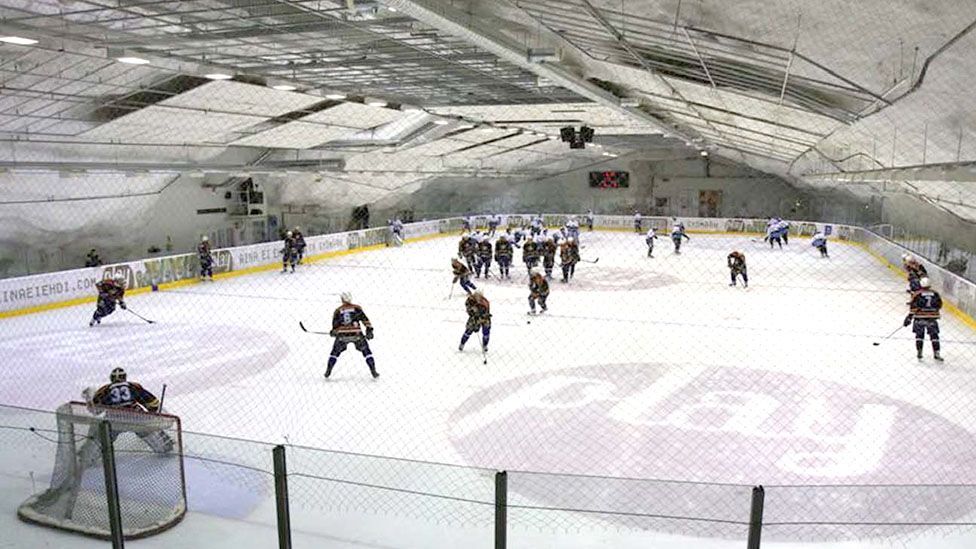
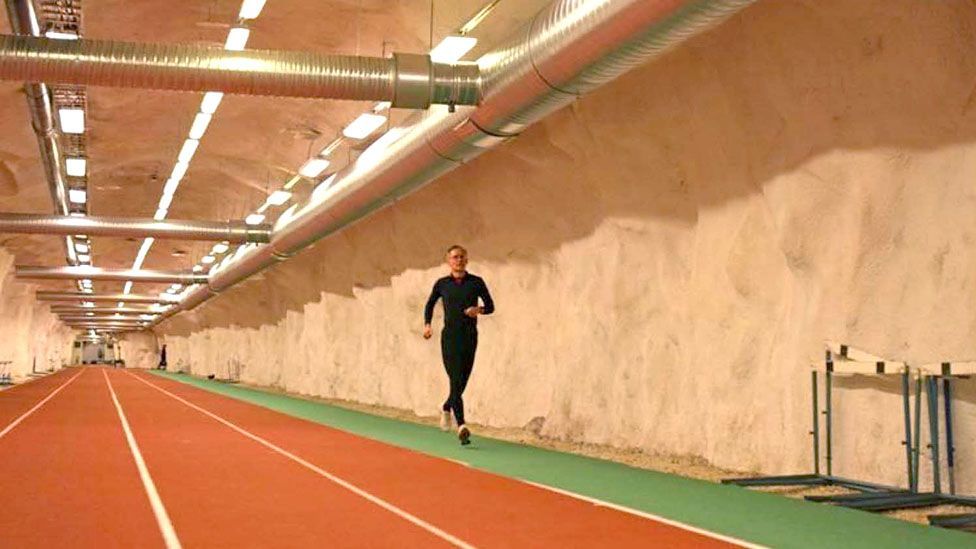
Helsinki'due south underground Hartwaal Arena (Credit: City of Helsinki)
Temperature is also a factor in Helsinki, Finland, where authorities accept built nine million cubic metres of facilities under the urban center – including shops, a running runway, ice-hockey rink and swimming pool.
Atomic number 82 designer of the urban center's underground primary program, Eija Kivilaakso, says weather underground are ofttimes more favourable than those above, especially in winter, when surface temperatures can driblet below -20C.
"With the weather in Helsinki, it's nice to work or get coffee underground – nosotros don't have to go out in the rain or the cold."
Dark fears
Information technology's technically possible to build underground living spaces for people. But are nosotros willing to spend long periods of time in subterranean dwellings? The success of building proposals like Mexico City'southward Earthscraper might depend on helping people overcome fears associated with the underground.
"The human heed is naturally predisposed to fear underground spaces, which it associates with dark, small, cavernous environments and a danger of being buried live," says Suarez.
But by connecting all areas of the Earthscraper to a large, fundamental, open space that receives light from above, Suarez hopes to change people's perception of the underground – he likens it to an open canyon.
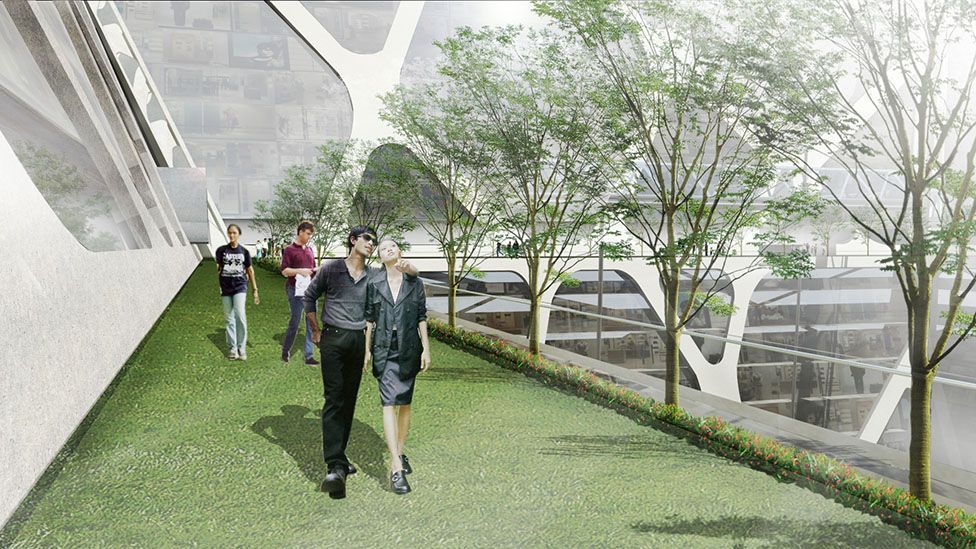
The Earthscraper has been designed so that people don't feel claustrophobic (Credit: BNKR Architectura)
For a minor percentage of people, the mere thought of beingness underground in a confined space can exist terrifying. Gunnar D Jenssen, who researches secret psychology and space pattern for Scandinavian research organisation SINTEF has found most 3% of people are severely claustrophobic – not having a clear mode out or being fearful of flooding or fires can crusade a lot of stress. Merely there are some way to counter their fears.
"If you requite these people something that gives them perceived control over the state of affairs, they take being in information technology. That is the key. Transferring that into architecture, into design is the line of piece of work we've been post-obit.
"The basic things you accept to have there is clean air, you accept to take the space, information technology has to be spacious or perceived [to be] spacious. You can employ illusions but the all-time is if it really is spacious and [has] practiced lighting."
Jenssen has worked on four of the longest road tunnels in the world. To create the illusion of space, within the tunnel he creates well-lit oases with palm trees and illusions of the heaven forth the route. "Yous get through a night tunnel and all of a sudden yous're coming out into a brilliant lit space with trees and plants.
"You lot have a feeling of animate space, a feeling of being outside, fifty-fifty though yous're 1,000 metres surreptitious going through a mountain."
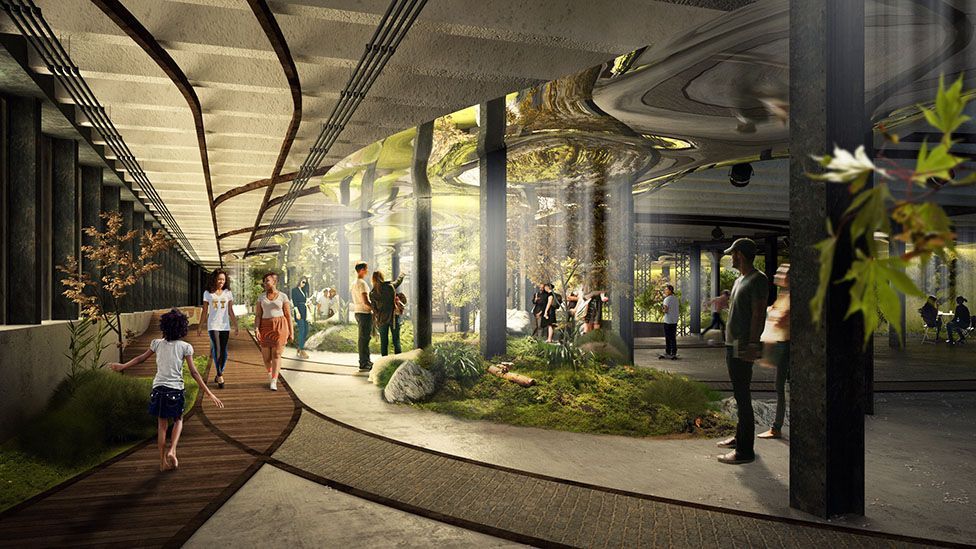
A design for New York City's Lowline, an underground park (Credit: Raad studio)
Using illusions and design tricks to make ourselves more comfortable underground is one matter, merely if we were to alive hush-hush, would we suffer adverse furnishings from a lack of sunlight?
Lawrence Palinkas, from the University of Southern California, says a lack of sunlight can cause difficulty with slumber, mood and hormone function which tin can produce chronic diseases of unlike varieties. Just, "timing and routine exposure to vivid low-cal that can mimic the properties of sunlight might enable people to live undercover for long periods of time".
Temporary abode
So, technically, nosotros can alive underground. Only volition we? Annette Kim, having seen first-manus the effects of Beijing's housing demands, thinks we might. "If we go along to accept this rapid urbanisation and people desire to come up to the big cities, we're going to have to, aye."
She says it likewise depends on how the space is used: "A lot of these people are going there to sleep at night. It'south not as if information technology's my 'dwelling house sugariness home' to hang out in – they savor the public spaces in a higher place basis to be in the sunlight and air."
Li Huanqing, a research fellow at Nanyang Technological University who made hole-and-corner urbanisation the focus of her doctoral thesis, says most cities are not planning hole-and-corner houses, but multifunctional hugger-mugger spaces that volition be occupied by shopping malls and public thoroughfares to gratis upward more than surface land for housing, green space and recreation.
Zhou says this makes sense. "There's no reason why people cannot live hole-and-corner," he says, but "there are a lot of things you can put cloak-and-dagger showtime".
Share this story onFacebook ,Google+orTwitter .

Source: https://www.bbc.com/future/article/20150421-will-we-ever-live-underground
Posted by: humphreylien1979.blogspot.com
0 Response to "Is It Easier To Build A Clean Room Underground?"
Post a Comment